Table of Contents
- Does Air Conditioning Cause Dry Eyes?
- Where Does This Show Up Most?
- Signs Air Conditioning Might Be Behind Your Dry Eyes
- How to Reduce Air Conditioning Dryness
- Conclusion
- Frequently Asked Questions
Have you ever noticed your eyes feel more irritated, scratchy, and dry in air-conditioned indoor environments? Offices, shopping centres, and cars all leave your eyes dry, sore, and gritty after prolonged exposure. You are not alone; air-conditioned environments are one of the most common, yet least discussed, drivers of dry eye disease.
Today, in this blog, we’ll discuss dry eyes and air conditioning in detail, why it happens, what it does to your eyes, and how to reduce it.
Does Air Conditioning Cause Dry Eyes?
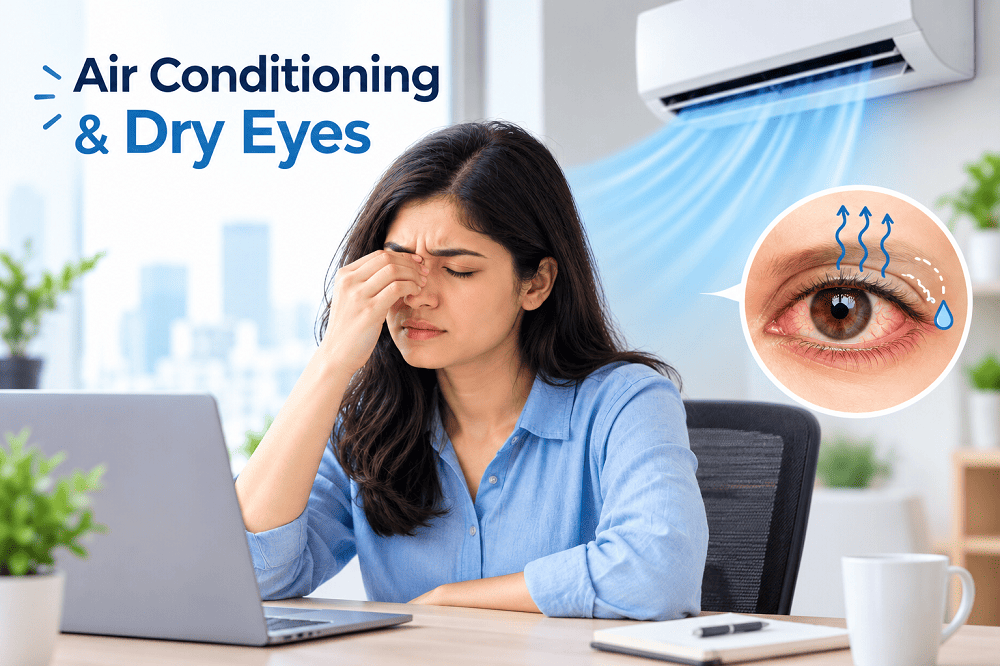
If you are wondering, does air conditioning cause dry eyes? Then yes, air conditioning causes dry eyes by lowering the humidity and causing tears to evaporate quickly. Here is the complete breakdown:
Low Humidity Speeds Up Tear Evaporation
Air conditioners cool your room by removing moisture from the air, leaving dry, cold air behind. The dry air has a significantly lower humidity compared to outdoor air. The thin oily (lipid) layer on top of your tears normally prevents quick evaporation. Dry, cool air breaks down and thins this lipid layer, exposing the watery layer underneath to rapid evaporation.
Airflow Direction Makes It Worse
Your eyes are protected by a tear film composed of mucus, water, and oil. Direct, steady drafts disrupt and thin out this film. When an AC vent blows directly towards your eye, the constant movement of cooled, low-humidity air forces the moisture on your eye’s surface to evaporate much faster than your tear glands can replenish it. And this dryness triggers the lacrimal glands to overproduce watery tears as an emergency response, which overflow without fixing the unstable, dry tear film.
Where Does This Show Up Most?
Air-conditioner-related dry eyes show up the most in centrally air-conditioned offices, cars, bedrooms, malls, etcetera.
Offices and Open-Plan Workspaces
Large shared offices rely on centralized, high-volume HVAC systems with sweeping, unobstructed air currents, so even if you aren’t sitting directly under a vent, you are exposed to a constant, subtle draft. This moving air accelerates the evaporation of the moisture layer on your eyes.
Cars and Public Transport
A car’s climate system and public transit’s HVAC units blow air at high velocity. If dashboard vents in a vehicle or overhead nozzles on a bus or train blow directly at your face, they create a constant wind tunnel. This rapid, directional blow of air breaks down the eye’s protective lipid layers and accelerates tear evaporation.
Planes and Travel
Normal places have 40 to 60% humidity, but airplane cabins feature very low humidity levels, about 10 to 20%; on top of that, planes have personal air nozzles constantly blowing cold, dry air at you. High-altitude cabin pressure changes reduce oxygen, which affects tear stability, giving you dry-eye symptoms.
Signs Air Conditioning Might Be Behind Your Dry Eyes
Air conditioning causes dry eyes because it lowers humidity indoors and blows dry air that evaporates your natural tear films too quickly. There are signs through which you can tell that your eyes are dry because of air conditioning:
- Your eyes feel hot, raw, or itchy from lack of moisture
- It feels like your eyes are filled with sand or dust
- Blood vessels on the surface of the eye turn pink or red
- Your eyes water heavily
- Your vision is turning hazy
- Your contact lenses feel scratchy
How to Reduce Air Conditioning Dryness
Redirect the Airflow
Keep your AC’s fan on auto mode instead of running it on high speed constantly, as the constant high-speed blow of air can speed tear evaporation; angle the AC vent upwards or away from you so the airflow can’t disrupt tear film stability.
Add Moisture Back to the Room
Running the humidifier alongside the AC is the fastest way to reduce air conditioning dry eyes. Put a cool mist humidifier at your home and a portable humidifier at your office desk, and aim for a humidity level between 40 and 50%, as at humidity below 40% your eyes will feel gritty.
Support Your Tear Film Through the Day
Use 2mg eye drops for dry eyes containing sodium hyaluronate 2 mg/mL (0.2% w/v) throughout your day if you are experiencing mild dry eyes to rehydrate them. Instill 1 to 2 drops into affected eyes as needed; using them 3-4 times a day is usually very helpful.
Conclusion
Dry eye is caused by low humidity and lack of moisture when you are in an air-conditioned room due to tear film instability and quick tear evaporation. Now that you know why you feel dry eye symptoms when you are in an air-conditioned environment and what causes dry eyes, you can take better care of your eyes by simply following some lifestyle and setup changes and keeping them healthy.
Frequently Asked Questions
Can Air Conditioning Make Dry Eyes Worse?
Yes, air conditioning lowers the humidity of the room by stripping moisture from the air, causing tears to evaporate faster than tear glands are able to replenish them.
Why Do My Eyes Feel Dry at Work but Not at Home?
At work, you are in an air-conditioned environment while working on a computer screen, which lowers your blink rate. The combination of an air-conditioned environment and a lower blink rate can intensify dryness in your eyes.
Does Turning Off the Air Conditioning Help Dry Eyes?
Yes, turning off the air conditioning can help relieve dry eyes. Turning off the air conditioner means the humidity level will no longer go down, helping you with dry eyes.
Can Lubricating Eye Drops Help With Air Conditioning Dryness?
Yes, lubricating eye drops will help with air conditioning dryness. Using 2 mg lubricating drops 3-4 times a day will help you rehydrate your eyes and can be very helpful.
Sources
- https://primeoptometrists.com.au/blog/air-conditioning-dry-eyes
- https://www.theeyelab.com.au/how-weather-affects-dry-eyes/