Table of Contents
- 1. What Are Preservatives in Eye Drops?
- 2. What Are Non-Preservative Eye Drops?
- 3. Preserved vs. Non-Preservative: Side-by-Side Comparison
- 4. Who Should Choose Non-Preservative Drops?
- 5. Which Dry Eye Drops Are Preservative-Free? – The OptiChoice Range
- 6. Who Might Still Use Preserved Drops?
- 7. Common Myths and Mistakes About Eye Drops
- 8. How to Choose the Right Eye Drops for You (decision checklist)
- 9. Quick Tips for Using Any Eye Drops Safely
- 10. Conclusion
- 11. Frequently asked questions
Are you experiencing irritation, discomfort, or stinging in your eyes from dry eyes? Fortunately, eye drops can provide relief, but many people are confused about which to buy: preserved or non-preservative.
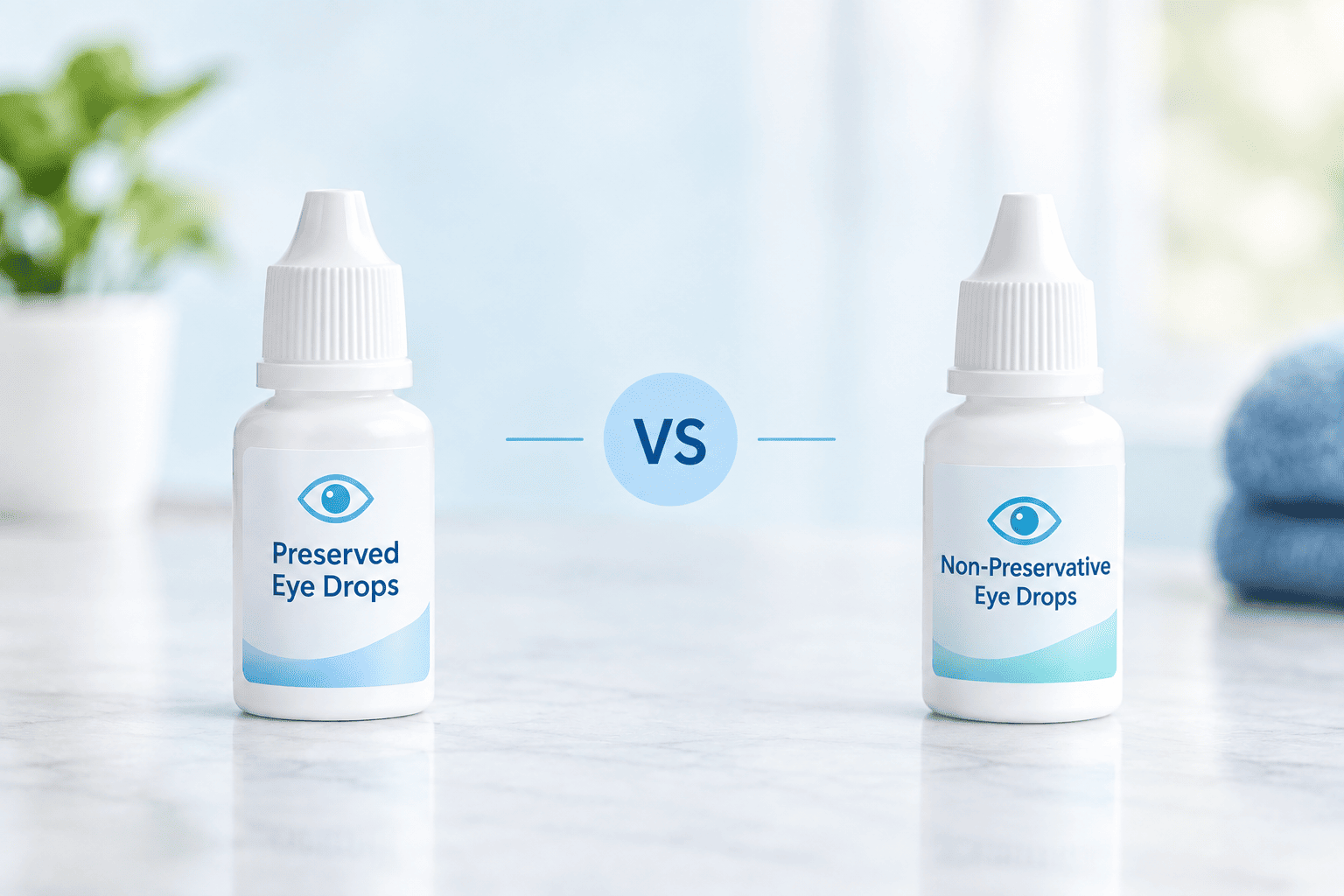
Both types of drops come with their own pros and cons. While preserved eye drops have a longer shelf life and prevent bacterial growth, they can cause irritation and discomfort in the eye. On the other hand, non-preservative eye drops minimise this irritation and can be used regularly, they have a shorter shelf life and can be a bit more expensive.
This blog explains the difference between both types, so you can decide which one is the right pick for you.
What Are Preservatives in Eye Drops?
Preservatives in eye drops are chemical or oxidising agents added to multi-dose bottles to prevent bacterial and fungal contamination after opening. Some of the common preservatives are:
- Benzalkonium chloride (BAK): A widely used detergent-based preservative; it is highly effective at destroying microbial cell walls, but it can be toxic to the human eye with chronic use.
- Polyquaternium-1 (Polyquad): It’s a larger polymer molecule that provides effective antimicrobial action while causing less damage to the surface of the eye compared to BAK.
- Oxidising Preservatives: These break down into harmless natural tear components like water, oxygen, and salt once exposed to light or the ocular surface, making them much gentler.
Preservatives kill or inactivate the microorganisms that enter the liquid every time the bottle is opened, and the dropper tip touches air, skin, or eyelashes. They allow eye drop bottles to remain stable, safe, and usable for weeks or months, rather than expiring in a very short period of time.
What Are Non-Preservative Eye Drops?
Non-preservative eye drops are sterile liquid drops that do not contain chemical additives to kill bacteria, unlike regular eye drops that use preservatives like BAK in multi-dose bottles, which makes them gentler and ideal for frequent use.
They are ideal for people with chronic dry eyes, allergies, or sensitive corneas, because you can use them as often as you need without any chemical buildup or irritation.
Non-preservative eye drops come in two different packaging options: One is single-use vials, disposable plastic tubes meant for one application only, and the other is special multi-dose bottles with advanced valves or a special filter to block bacteria without adding chemicals.
Preserved vs. Non-Preservative: Side-by-Side Comparison
Understanding the difference between both types will help you decide which one you should go for based on your frequency of use, skin or eye sensitivity, and convenience preference. This side-by-side comparison shows you the clear distinction between both:
| Features | Preserved eye drops | Non-preservative eye drops |
|---|---|---|
| Additives | Contains chemicals like Benzalkonium chloride (BAK) | No added preservatives |
| Packaging | Standard multi-dose dropper bottle. | Single-dose vials or specialised multi-dose filter bottles. |
| Shelf life | Longer shelf life, often months to years after opening. | Shorter shelf life compared to its counterparts; single-use vials are discarded immediately after opening. |
| Ocular safety | Can cause irritation, stinging, or surface toxicity with frequent or long-term use. | Gentler on the eyes; lower risk for surface inflammation and toxicity. |
| Usage frequency | Usually restricted to a maximum of 4 times a day due to potential toxicity. | Can be used frequently throughout the day without risk of chemical buildup. |
| Contamination risk | Very low; chemical barriers kill bacteria. | Higher once opened; relies on sterile mechanical packaging. |
| Cost | More affordable | Generally more expensive |
Who Should Choose Non-Preservative Drops?
Chronic Dry Eye Patients and Frequent Users:
People who are managing moderate dry eye syndrome and require ongoing moisture and have to apply drops multiple times daily. If you apply the normal preserved drops multiple times daily, you will expose your cornea to chemicals like BAK, which can damage the tear film over time.
Hence, you need to switch to non-preservative drops because chemical irritation and inflammation are the last thing you would want after using your eye drops.
People who wear contact lenses
When you apply eye drops containing preservatives, the contact lens’s matrix absorbs these chemicals. The preservatives remain trapped inside the lens material, creating a small reservoir that constantly releases chemicals directly onto the cornea for hours.
This prolonged, concentrated exposure to preservatives can destabilise your natural tear film, which leads to chronic irritation, stinging, and redness. Switching to non-preservative drops will allow you to safely rehydrate the eye directly through the lens without any chemical buildup.
Which Dry Eye Drops Are Preservative-Free? – The OptiChoice Range
OptiChoice makes some of the best preservative-free eye drops for mild to moderate and severe dry eyes. Their core products are non-preservative 2mg and 4 mg lubricating eye drops.
2 mg preservative-free eye drops: These lubricating eye drops contain sodium hyaluronate 2mg (0.2% w/v) sodium hyaluronate eye drops and are designed to support the tear film in mild to moderate dry eye. The formulation helps relieve dryness, soothe irritation, and maintain moisture for everyday eye comfort, while remaining gentle enough for regular use.
4mg eye drops without preservatives: These Eye Drops contain sodium hyaluronate 4 mg/mL (0.4% w/v) and are formulated to provide lubrication for eyes requiring longer‑lasting moisture. Compared to 2 mg/mL, this is formulated to support tear‑film stability while remaining comfortable for regular use. Unlike the 2mg one, you should not use this before consulting an eye doctor.
Who Might Still Use Preserved Drops?
Occasional or infrequent users
For people who only experience temporary dry eyes due to a long flight, a windy day, or an occasional late night staring at a screen, preserved eye drops are completely fine.
Because you use the drops less than four times a day, the chemical concentration never builds up; a naturally healthy tear film can easily dilute and flush away the tiny amount of preservatives before it can cause any damage.
People who want both affordability and convenience
Non-preservative eye drops are significantly more expensive to manufacture, package, and ship. A standard multi-dose bottle of preserved drops is way cheaper compared to a non-preservative one.
Also, a bottle of preserved eye drops does not expire till a month after opening and is easier to carry around in a purse because of preservatives like BAK.
Common Myths and Mistakes About Eye Drops
People believe multiple things related to eye drops, and they end up intensifying the discomfort; for example, a lot of people believe that if you add more drops, you will have better results, which is not true; your eye can only hold one drop at a time, extra drops will overflow, and you will end up wasting the drops.
So here is the list of common mistakes people make so you don’t repeat them.
- Touching the dropper tip: Letting the tip touch your skin, eyelashes, or fingers introduces bacteria into the bottle.
- Applying multiple drops too quickly: If you need a second type of drop, wait at least 5 to 10 minutes between applications so the first one can get absorbed.
- Ignoring expiration date: Expired eye drops can lose potency and harbor harmful bacteria.
- Not washing your hands before and after eye drops: Your hands constantly collect invisible pathogens from everyday surfaces that can easily bypass the eye’s natural defenses.
How to Choose the Right Eye Drops for You (decision checklist)
1: Check your usage frequency
If you are using your eye drops 4 or more times a day, choose non-preservative eye drops; in any other case, you can use preserved drops.
2: How sensitive are your eyes?
If you have sensitive eyes, allergies, or you’re recovering from eye surgery, you should not use preserved eye drops.
3: Are you wearing contact lenses?
If you wear contact lenses, you absolutely cannot use preserved eye drops.
4: What’s your budget
If you want budget-friendly eye drops, you can use preserved drops; non-preservative ones are better.
Quick Tips for Using Any Eye Drops Safely
Regardless of whether you are using preserved or non-preservative eye drops, you need to follow some safety cautions to ensure you don’t further damage your eyes:
- Wash your hands before you use your eye drops.
- Avoid touching the nozzle to your eye, as this could cause a bacterial infection.
- Space out the doses equally.
- Never leave your eye drops in hot environments.
- Throw away the eye drops after the expiration date on the bottle.
- Follow the dosage recommended by your doctor.
- If you are experiencing any irritation, discomfort, or allergic reactions, cease use immediately and consult your optometrist.
Conclusion
Both preserved and non-preservative eye drops have their own pros and cons, while the preserved one is a more affordable and convenient option; however, its frequent use will harm your eyes.
Non-preservative costs more, but it is an ideal option that you can use frequently without worrying about external chemicals and preservatives. It is essential that you understand your condition precisely before deciding which drops to choose.
Frequently asked questions
What is the difference between preserved and non-preservative eye drops?
Preserved eye drops have preservatives like BAK and Polyquad, which can harm your cornea if used frequently, while non-preservative eye drops do not contain any additives.
Are non-preservative eye drops better?
Non-preservative eye drops are better if you use artificial tears four or more times a day or have sensitive, chronically dry eyes.
Which eye drops are preservative-free?
Optichoice 2mg and 4mg lubricative eye drops containing 2 mg/mL (0.2% w/v) and 4 mg/mL (0.4% w/v) sodium hyaluronate are good preservative-free eye drops.
Sources:
- https://dryeyerescue.com/blogs/everything-dry-eye/difference-between-preservative-and-preservative-free-eye-drops
- https://www.visiondirect.co.uk/eye-care-centre/preservative-free-eye-drops